

Body Roundness Index (BRI) vs Body Mass Index (BMI): What’s the Difference?
Body Mass Index (BMI) has limitations, as it doesn’t consider fat distribution. The Body Roundness Index (BRI) improves on this by factoring in waist circumference to estimate visceral fat, which is linked to metabolic risks. For personalized health advice, it’s important to consult professionals at NY Medical Weight Loss to ensure a tailored approach to your health and weight loss goals. For more information, contact us or request an appointment online. We are conveniently located at 65 Hilton Ave #250, Garden City, NY 11530.

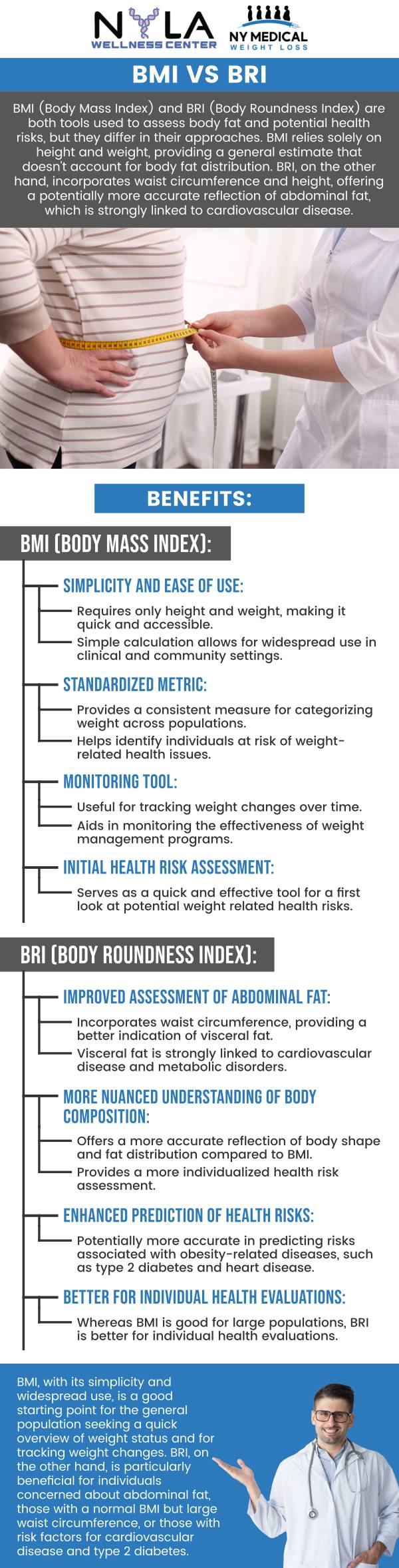
Table of Contents:
What is the difference between Body Roundness Index (BRI) and Body Mass Index (BMI)?
How is Body Roundness Index (BRI) calculated compared to BMI?
Why is BRI considered a more accurate measurement than BMI?
Can Body Mass Index (BMI) and Body Roundness Index (BRI) be used together for health assessment?
BMI is a traditional and widely recognized measurement—calculated by dividing your weight in kilograms by the square of your height in meters. BMI is an initial screening tool to categorize your weight status (such as underweight, normal weight, overweight, or obese). However, we recognize that BMI has limitations: it does not distinguish between muscle and fat mass, nor does it provide information about where fat is distributed in your body. For example, two people could have the same BMI but very different health profiles and risks.
To offer a more complete picture, we also utilize the Body Roundness Index (BRI). Unlike BMI, BRI incorporates both your height and your waist circumference, giving us a clearer understanding of how fat is distributed—especially around your midsection. This is important because abdominal fat is more strongly associated with health risks such as heart disease and diabetes. By including BRI in our assessment, we can identify individuals who may have a “normal” BMI but still carry excess abdominal fat, which may increase their risk of certain health problems.
By incorporating both BMI and BRI into our evaluations, we are able to tailor our weight loss programs to your specific needs, monitor your progress more accurately, and address health risks that might be missed by traditional methods alone. This comprehensive approach ensures that you receive the most effective, individualized care as you work toward your weight loss and health goals.
BMI is a traditional, quick calculation based on your weight and height (kg/m²). It’s a helpful screening tool that classifies individuals as underweight, normal weight, overweight, or obese. However, BMI has its limitations. It does not differentiate between muscle and fat, nor does it indicate where fat is distributed in the body—factors that are crucial for understanding your true health risks.
BRI is a more advanced measurement that takes into account both your height and waist circumference. This allows us to estimate your body fat percentage and, importantly, the amount of visceral (abdominal) fat you may be carrying. Since excess abdominal fat is more closely linked to serious health risks like heart disease and type 2 diabetes, BRI provides us with a clearer picture of your overall risk profile.
By incorporating both BMI and BRI into our personalized weight loss and wellness programs, we are better equipped to guide your progress and tailor interventions that target not just your weight, but also the specific health concerns that matter most.
BMI has long been used to categorize weight status; it does not distinguish between muscle and fat mass, nor does it account for where fat is distributed in the body. This can sometimes lead to misleading results—especially for individuals with higher muscle mass or those whose weight may fall within a “normal” range but who still carry excessive abdominal fat.
BRI goes a step further by incorporating waist circumference along with height, giving us a much clearer picture of your body composition and fat distribution. Central adiposity—fat accumulation around the abdomen—is a significant factor in the development of metabolic diseases. By measuring BRI, our team at NY Medical Weight Loss can better identify patients who may be at increased risk for these health issues, even if their BMI appears normal.
Our use of BRI allows us to tailor treatment plans more precisely, targeting not just weight loss but also the reduction of health risks associated with central obesity. This approach helps us provide you with the most effective strategies for long-term health and wellness.
BMI is a widely used calculation that takes into account your weight and height to determine if you fall within a healthy weight range. While helpful as an initial screening tool for underweight, normal weight, overweight, or obesity, BMI does not distinguish between fat and muscle mass or show where fat is distributed in the body.
That’s why NY Medical Weight Loss also utilizes the Body Roundness Index (BRI)—a newer and more advanced metric that combines your waist circumference and height. BRI is especially valuable because it estimates the amount and distribution of body fat, particularly abdominal (visceral) fat. This type of fat is closely linked to increased risk of chronic conditions such as heart disease, diabetes, and metabolic syndrome.
Why Do We Use Both BMI and BRI?
By using both BMI and BRI, our team can offer a more complete picture of your health. For example, two individuals might have the same BMI, but if one has a higher BRI, they may be at greater risk for health complications related to central obesity. This dual approach allows us to more accurately identify patients who could benefit from targeted interventions and personalized weight loss plans.
Our Commitment to Your Health
You can expect a thorough and individualized assessment. Combining BMI and BRI enables our medical professionals to detect potential health risks related to both overall and abdominal obesity, helping us make more informed clinical decisions. This means you receive recommendations and care tailored to your unique needs—not just a number on the scale. For more information, contact us or request an appointment online. We are conveniently located at 65 Hilton Ave #250, Garden City, NY 11530. We serve patients from Garden City NY, Mineola NY, Hempstead NY, Franklin Square NY, Westbury NY, Roosevelt NY, and surrounding areas.
Check Out Our 5 Star Reviews


Additional Services You May Need
▸Medical Weight Loss
▸Peptides
▸Testosterone Replacement Therapy
▸B12 Shots
▸Semaglutide
▸Emshape Neo-X
▸Skin Tightening
▸Stretch Mark Removal
▸Cellulite Reduction
▸Body Slimming
▸Anti-Aging Peptides
▸NAD+ IV Therapy
▸Sermorelin Acetate
▸Lipotropic Injections
▸3D Body Scanner
▸Invisa-RED
▸Immune Booster
▸Myers Cocktail
▸IV Therapy
▸EmSculpt

Additional Services You May Need
▸Medical Weight Loss
▸Peptides
▸Testosterone Replacement Therapy
▸B12 Shots
▸Semaglutide
▸Emshape Neo-X
▸Skin Tightening
▸Stretch Mark Removal
▸Cellulite Reduction
▸Body Slimming
▸Anti-Aging Peptides
▸NAD+ IV Therapy
▸Sermorelin Acetate
▸Lipotropic Injections
▸3D Body Scanner
▸Invisa-RED
▸Immune Booster
▸Myers Cocktail
▸IV Therapy
▸EmSculpt



 Send Text
 How May I Help You?